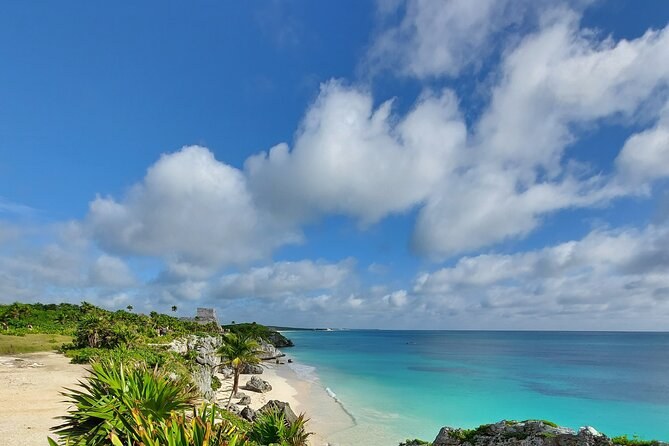
Casa Cenote: the Tulum Cenote That Runs to the Sea
Not a sinkhole at all. Casa Cenote is where every drop of groundwater under this coast finally reaches the Caribbean — a brackish channel through mangrove, with layers you can see and a resident that made the news in May 2026.
A channel, not a sinkhole
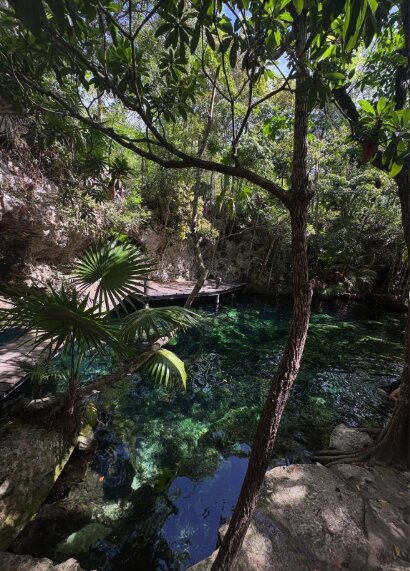
Casa Cenote breaks the definition. There is no collapsed roof and no hole in the ground; there is a channel of clear water roughly 230 metres long, winding through mangrove about fifteen minutes north of Tulum town on the coast road.
You do not swim lengths of it. You float it, or paddle it, following the current between root walls with the sky open above you the whole way. It takes as long as you let it, and most people take longer than they planned.
Where the fresh water meets the sea
This is the end of the system. Everything that fell as rain inland and moved sideways through the limestone arrives here and reaches the Caribbean, which makes the water brackish — fresh sitting on salt, in visible layers.
Swim down a metre and the view goes soft and oily where the two meet, then sharp again below it. That shimmer is a halocline, the same phenomenon divers go to Cenote Calavera for, except here you meet it in two metres of water wearing a snorkel.
Panchito, and what changed in May 2026
A Morelet's crocodile of about two metres has lived in this channel since he was young. He is called Panchito, he is genuinely there, and for years the encounter was sold as the attraction.
That changed on 12 May 2026. Panchito bit a 75-year-old visitor who was in the water, injuring an arm and both ankles. Witnesses said several people had been throwing stones at the animal minutes beforehand to provoke a reaction for video. Tulum's municipality, with Civil Protection and PROFEPA, announced that activities which disturb the animals — swimming and diving right beside them — would be restricted. The crocodile stays: Morelet's crocodile is protected under NOM-059-SEMARNAT-2010. What to do instead: the mangrove, the halocline and the fish are all still there and all still worth the morning, and the safety page sets out how to be in this water properly.
So the honest position today is that you do not swim with the crocodile. You may well see one, from a distance, from a paddleboard or from the bank, and that is a better photograph anyway.
Paddleboard, snorkel or dive
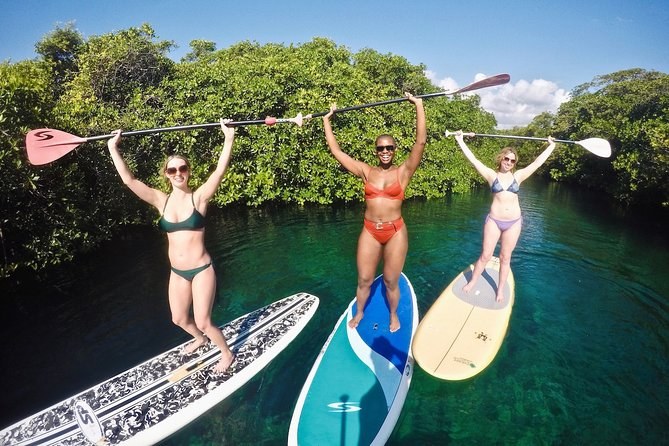
A paddleboard is the best way to see the length of it, because it puts your eyes above the surface where the birds and the roots are and keeps you out of the animals' way. One departure listed here does exactly that and caps the group at five.
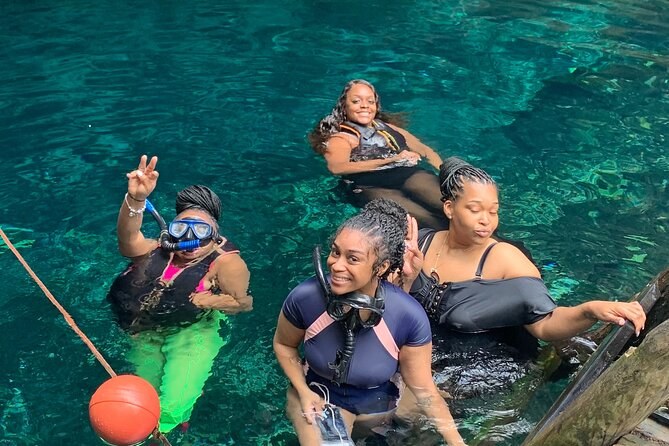
Snorkelling shows you the other half: the halocline, the fish stacked under the mangrove roots, the light coming through in bars. Divers come for the same reasons in slower motion. All three are surface-accessible — there is no cavern here and no certification needed.
The board is the one worth thinking about, because it covers ground a snorkeller will not: the channel runs several hundred metres and most people swim a fraction of it. the three-cenote morning that ends here crosses the whole thing and then puts you in the water at the mangrove end.
The mangrove, and what lives in it
The root walls on either side are the reason this cenote looks nothing like the others. Mangroves grow where fresh and salt water mix, and the tangle of roots is nursery habitat: small fish in their thousands, then the things that eat them.
Because the water is brackish you get species you will not find in a freshwater cenote inland. It is the most biologically interesting water on this list and the least dramatic to photograph, which is roughly the opposite of Taak Bi Ha.
The birds, and the hour they are there
Mangrove is nursery habitat, and where there are small fish in numbers there are herons standing very still at the edges of them. Early morning is when the channel is busiest above the waterline as well as below it.
Come at eight and you share the place with wading birds and almost nobody else. Come at noon and you share it with paddleboards. The wildlife has not gone anywhere; it has simply moved out of the middle, which is what wildlife does when a channel two hundred metres long fills up.
Combining it with Akumal and the coast
Casa Cenote sits on the coast road, which puts it on the same axis as Akumal Bay rather than the Cobá-road cenotes. Several departures listed here pair a cenote with snorkelling among sea turtles at Akumal, and geographically that pairing makes far more sense than a cenote plus the ruins.
If you are building a day yourself, the honest order is turtles first while the bay is calm, then this channel in the middle of the afternoon when the light gets into the mangrove sideways. The planning page sets out both versions with times.
The manatees it is named after
The other name for this place is Cenote Manatí, and it is not decorative. Manatees used to come into the channel from the sea to feed, which is how it got the name.
They are rare here now. Nobody should book this expecting one, and no operator promises one. The name is a record of what the coast used to hold, which is a more interesting fact than a sighting would be.
Doing it from Tulum town
Fifteen minutes north on the coast highway, past the turn for Tankah. A taxi is the simple answer; a colectivo on the Cancun road will drop you at the junction and leave you a short walk in. It does not combine with the Cobá-road cenotes in half a day, because they are in the other direction.
Entry is cash at the gate and gear is hired there. Three departures listed here include this cenote in the fare, and the half-day page has the two that make a morning of it.
| Where | About 15 minutes north of Tulum town on the coast road |
| Type | Open brackish channel, roughly 230 m long |
| Water | Fresh over salt — you can see the layers move |
| Known for | Mangrove roots, a resident Morelet's crocodile, and the manatees it is named after |
| Gear | Snorkel, paddleboard or kayak; life jackets on site |
Casa Cenote at a glance. Depths and distances from published survey and guide sources; what a fare covers is read from each operator's own listing.
Know before you go
Do not approach the crocodile
Since May 2026 swimming and diving alongside them is restricted here. Watch from a board or the bank, and you still get the photograph.
A paddleboard beats a snorkel for the length
Two hundred and thirty metres is a long way to swim and a short way to paddle. Snorkel the sections that interest you from the board.
Look for the shimmer at a metre down
That blur is fresh water sitting on salt. Dive through it slowly and you will see the view sharpen again below.
Early is for the birds, literally
Herons work the root walls first thing. By midday the middle of the channel is boards.
It does not combine with the Cobá road
This is the coast, in the other direction. Pair it with Akumal rather than with Gran Cenote.
Brackish means rinse your kit
Salt in the water means salt in your mask strap. Rinse gear properly afterwards or it perishes.
Questions about Casa Cenote
Can you still swim at Casa Cenote after the crocodile attack?
Yes. What Tulum's authorities restricted in May 2026 was swimming and diving alongside the crocodiles, not use of the channel. The mangrove, the halocline and the fish are all unchanged, and the rule simply means you keep your distance.
Is Casa Cenote salt water or fresh?
Both, in layers. Fresh groundwater sits on salt water pushing in from the sea, and you can see the boundary shimmer about a metre down. That is what makes it brackish and why the wildlife differs from an inland cenote.
Is Casa Cenote good for a beginner snorkeller?
It is one of the best on this coast for one. The water is shallow through most of the channel, there is no roof, the current is gentle and there is always a root wall within reach. Life jackets are on site.
What is the difference between Casa Cenote and Cenote Manatí?
There is none — they are two names for the same channel. Manatí is the older one, from the manatees that used to come in from the sea to feed. They are rare here now.
Address, hours and the map
Casa Cenote
Carretera Federal Tulum-Cancun km 236, Tankah, 77780 Tulum, Quintana Roo, Mexico
Hours
Gates here open at about 8:00am and stop admitting swimmers in the mid-afternoon. Casa Cenote is run by the owners of the land it sits on, so those edges move and are not published anywhere central.
What it costs
Cash, in pesos, at the gate. No tariff is published for it and none is printed here — see what you pay and to whom for why, and for the departures whose fare covers it instead.
Getting here
It sits off the coast highway north of Tulum, past the turn for Tankah. A taxi from town takes about fifteen minutes; colectivos on the Cancun road will drop you at the junction and leave you a short walk in.
Coordinates
20.2694°N, 87.4179°W
Departures that go into Casa Cenote
Read from each listing's own itinerary, not from its title — these are the trips that actually stop at Casa Cenote.