Cenote Taak Bi Ha: the Lit Cavern in the Tulum Cenotes
The one with no sky. A stairway drops into a sealed chamber of stalactites lit by the cooperative that runs it, held at 25 degrees whatever the month, and reached only by the departures willing to handle a track and two separate gates.
A cavern with no sky
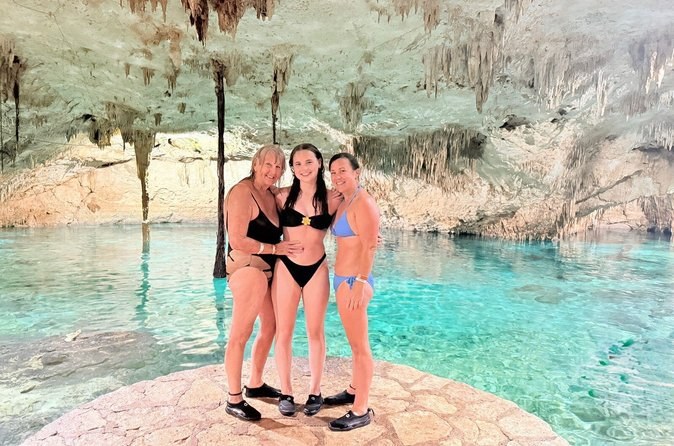
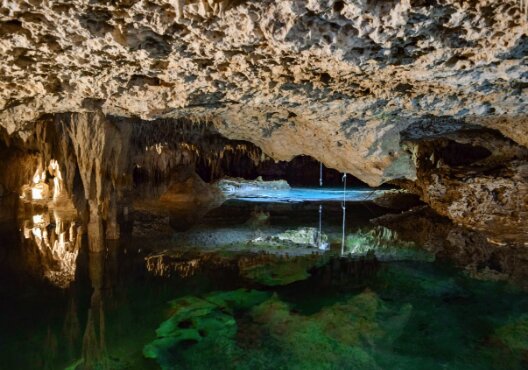
A stairway drops through the limestone into a chamber that has no opening at all. There is no shaft of daylight here, no warm shallow edge and no view out. There is a stone floor, a waterline, and stalactites coming down to meet their own reflection.
That is the entire proposition, and it is either exactly what you came for or exactly what you did not. If you want sky above you while you swim, Gran Cenote gives you both halves and lets you decide.
What the enclosure buys is silence and stillness. Nothing moves in a sealed chamber: no wind on the surface, no leaves falling in, no glare. The water is flat enough to hold a perfect reflection of the formations above it, which is the shot everyone comes away with and the reason the place has a reputation well beyond its size.
Eight metres, and 25 degrees all year
The water reaches about eight metres at its deepest, which is shallow for a cavern and part of why it works for snorkellers rather than only divers. You float over formations rather than descending to them.
Because no sunlight ever reaches it the temperature does not move: it sits between 25 and 26 °C in February and in August alike. It is the only cenote on this list where the month you visit changes nothing at all about the water, which the month-by-month page makes more of.
Eight metres is also shallow enough that a snorkeller sees the floor. In a deeper cavern the formations recede into blue and you are looking at a suggestion of a cave; here the whole chamber is legible from the surface, which is why it works for swimmers rather than only for divers.
Why it is lit, and what that does to a photograph
Sections of the chamber are artificially lit by the cooperative that runs it. That is unusual and it is deliberate: without it there would be nothing to see beyond the first few metres.
The practical consequence is that a photograph here does not depend on the hour you arrive. Everywhere else on this coast the picture is a light shaft that exists for about an hour either side of noon. Here the lighting is fixed, which makes this the most reliable camera stop near Tulum — and the one where you should check the device rules before you carry anything in.
Opened in 2018, run by a cooperative
It only opened to the public in 2018, which is why it is missing from older guidebooks and why it is quieter than its neighbours. A Maya cooperative runs it and charges separately from the main Parque Dos Ojos gate, even though it sits inside the same park.
That separation is worth understanding before you arrive: paying at the park entrance does not get you in here. Departures that include it handle both payments, and their listings say so.
If enclosed water is not for you
This is your cenote if
You want stalactites within arm's reach, water that is the same temperature whatever month it is, and a photograph that does not depend on the sun. It is also the calmest water here — nothing moves in a sealed chamber.
Book something else if
Enclosed spaces bother you. One traveller says plainly in their own review of a comparable underground swim that it is not a good idea for anyone claustrophobic, and they are right. Cenote Zacil-Ha is three metres deep, open to the sky and about as unthreatening as water gets.
The private departures that go in, and what they cover
Three of the departures listed here name this cenote in their own itinerary, and all three are private. That is not a coincidence: it is inside a park, up a track, behind a second payment, which is exactly the kind of logistics a shared coach avoids.
All three include the entry in the fare, so there is nothing to pay at either gate. Two of them pair it with the Tulum ruins in the morning and the cavern afterwards, which is the right order — ruins in the cool, water in the heat. The private tour page costs that out.
| Where | Inside Parque Dos Ojos, paid separately from the main gate |
| Type | Fully enclosed cavern — no opening to the sky |
| Depth | About 8 m (26 ft) at its deepest |
| Water | 25–26 °C all year, because no sun reaches it |
| Opened | 2018, run by a Maya cooperative |
Cenote Taak Bi Ha at a glance. Depths and distances from published survey and guide sources; what a fare covers is read from each operator's own listing.
Every one of them is private, and that is not a coincidence: the cooperative takes a separate payment from the main park gate, so a coach cannot run the stop without stopping twice. The four-to-five-hour private day is the one that covers both payments and adds Parque Dos Ojos on the same ticket.
See every private Tulum Cenote tour
Know before you go
There is no sky
None at all, at any point. If enclosed water bothers you, this is the one to swap for an open cenote.
The temperature never changes
25–26 °C in February and August alike. The month you visit changes nothing here.
Photographs do not depend on the hour
The chamber is lit. Come at any time the gate is open and get the same picture.
Check the device rules before you carry anything in
Several cenotes on this coast ban phones and cameras in the water outright. Ask at the gate rather than at the waterline.
It is paid separately from the park
A different cooperative runs it. Departures that include it handle both payments.
The stairs are steep and wet
Limestone, cut, and slick at the bottom. Shoes with a grip matter more here than at any open cenote.
Questions about Taak Bi Ha
Is Cenote Taak Bi Ha claustrophobic?
It is fully enclosed, with no opening to the sky at any point, so for some people yes. The chamber itself is large and lit rather than tight and dark. If enclosed water bothers you at all, an open cenote is the better morning.
Do you pay separately for Taak Bi Ha inside Parque Dos Ojos?
Yes. A Maya cooperative runs it and charges at its own gate, so paying at the main park entrance does not cover it. Departures that include this cenote handle both payments in the fare.
Why is Cenote Taak Bi Ha lit?
Because without lighting there would be nothing visible past the first few metres. The cooperative installed it deliberately, and the practical effect is that a photograph here does not depend on the time of day.
How cold is Cenote Taak Bi Ha?
Between 25 and 26 °C, and it does not move. No sunlight reaches the chamber at any point in the year, so February and August feel identical in the water.
Address, hours and the map
Cenote Taak Bi Ha
Taak Bi Ha, Parque Dos Ojos, Xel-Ha, 77762 Tulum, Quintana Roo, Mexico
Hours
Gates here open at about 8:00am and stop admitting swimmers in the mid-afternoon. Taak Bi Ha is run by the owners of the land it sits on, so those edges move and are not published anywhere central.
What it costs
Cash, in pesos, at the gate. No tariff is published for it and none is printed here — see what you pay and to whom for why, and for the departures whose fare covers it instead.
Getting here
Inside Parque Dos Ojos, up the same track, and paid for separately from the main park gate because a different cooperative runs it. Every departure that goes here handles the track and both payments for you.
Coordinates
20.3238°N, 87.3862°W
Departures that go into Cenote Taak Bi Ha
Read from each listing's own itinerary, not from its title — these are the trips that actually stop at Taak Bi Ha.