Cenote Calavera: the Temple of Doom in the Tulum Cenotes
Three holes in a limestone roof that read as a skull from above, which is where both its names come from. You drop through the largest of them into water fifteen metres deep, a kilometre and a half from the middle of Tulum town.
Three holes in a roof, and a name
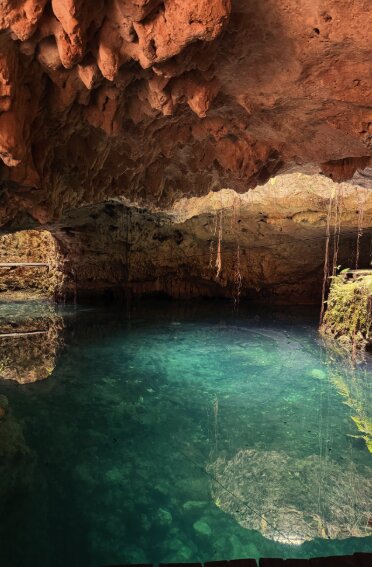
From above, the roof of this cenote has three openings in it: one large and two small, arranged so that they read as a skull. Calavera is Spanish for skull, and the English nickname the dive shops use is the Temple of Doom.
Both names are about the same three holes. There is nothing sinister here and nothing archaeological; it is a piece of collapsed limestone that happens to have fallen in a shape people recognise.
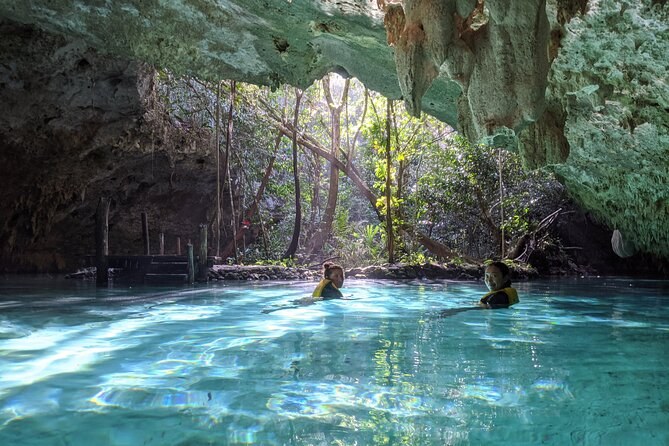
The shape does something useful, though. Three openings put three separate columns of light into one body of water from three angles, and where they cross the water goes luminous in a way a single roof hole cannot manage. That is what the photographs are of, and it is why this cenote outperforms its size.
The jump, and the ladder beside it
You get in through the largest opening. Most people jump; there is a wooden ladder bolted beside it for everyone who would rather not, and using it is not a lesser visit.
The two small holes are for looking through rather than dropping through. Anyone who has watched a video of this place has watched somebody go through the big one, and the water directly under it is deep enough for that to be a normal thing to do rather than a brave one.
Three metres at the edge, sixteen in the middle
The floor drops away fast. At the edges you are in about three metres of water; in the centre it runs to fifteen or sixteen, and the deepest part of the cavern is around sixteen metres.
That shape is what makes it work as a jump cenote and what makes it a diver's site as well. It also means there is no shallow shelf to stand on while you get your breath, which is worth knowing if you are a nervous swimmer. Take the life jacket.
It also explains the water temperature, which surprises people who have already swum an open cenote that morning. A deep column under a roof does not warm through, so this is noticeably colder than Zacil-Ha up the same road, and the first thirty seconds after a jump are the proof of it.
The haloclines, and why the water blurs
Divers here pass through three separate haloclines, the first at about ten metres. A halocline is the boundary where fresh water sits on salt water, and crossing one makes the view go oily and unfocused for a moment before it sharpens again.
You will not reach those from the surface. What you can see from a snorkel is the light from three holes converging in the same volume of water, which is the reason the photographs look the way they do. Casa Cenote is where you meet a halocline in two metres of water instead.
Reaching it from Tulum town
This is the closest cenote to town on the list — about a kilometre and a half out on the Cobá road. A taxi takes five minutes. A bicycle takes ten, on flat tarmac, and you will pass the turn before you have warmed up.
There is no reason to drive and no reason to book transport. Entry is cash in pesos at the gate, there is no published tariff for it, and gear is hired on site if you want any.
An hour, not a day
Plan an hour. It is one pool, you enter it one way, and once you have jumped twice and floated for twenty minutes you have had the experience it offers.
That is a feature rather than a criticism. It combines: an hour here at nine, Gran Cenote at ten, and you are back in town for lunch having swum two cenotes for the price of two gate fees and a colectivo. The planning page costs that morning out properly.
| Where | A short ride from Tulum town on the Cobá road |
| Type | Roofed sinkhole entered from above |
| Depth | About 3 m at the edges, 15–16 m in the middle |
| Known for | The jump, and three haloclines the first at about 10 m |
| Reached by | Bike, colectivo or taxi — no tour here goes in |
Cenote Calavera at a glance. Depths and distances from published survey and guide sources; what a fare covers is read from each operator's own listing.
That is the honest length of a Calavera visit, and it is why nothing is sold around it. If you would rather spend the morning in water than organising three gate payments, the private underground-river morning fills the same hours with an enclosed cave instead and collects nothing on the day.
Nothing listed here goes in — and that is the honest answer
No departure listed here names Cenote Calavera in its itinerary, and none is going to. It is close enough to town, cheap enough at the gate and short enough as an experience that there is nothing for an operator to sell.
So the useful thing this page can do is say that plainly, and then tell you what a guided day buys instead: the cavern cenotes off the highway that need a vehicle and a second gate payment, and the ones an hour up the coast. That is a different day from this one, not a better version of it, and the comparison puts them side by side.
Know before you go
The ladder is not a lesser visit
It is bolted beside the main opening for exactly this reason. Use it and you have still swum the cenote.
There is no shallow shelf
Three metres at the edges, sixteen in the middle, and nowhere to stand and catch your breath. Take the life jacket.
Only the large hole is for entering
The two small ones are for looking through. Nobody goes in through those.
An hour is the visit
One pool, one way in. Combine it with Gran Cenote up the same road rather than planning a morning here.
A bicycle is genuinely the best option
A kilometre and a half on flat tarmac. A taxi is five minutes and a car is a parking problem.
Haloclines are a diver's phenomenon here
You will not reach ten metres on a snorkel. For a halocline at arm's length, go to Casa Cenote instead.
Questions about Calavera
Do you have to jump into Cenote Calavera?
No. A wooden ladder is bolted beside the main opening and plenty of people use it. The jump is the photograph, not the entry requirement.
How deep is the water under the jump?
Deep enough that it is a normal thing to do rather than a brave one. The centre runs to fifteen or sixteen metres and the edges to about three, with the deepest part of the cavern around sixteen.
Why is it called the Temple of Doom?
It is a dive-shop nickname for the same three holes that give it the Spanish name. Calavera means skull, and from above the openings read as one. There is nothing archaeological or sinister about the place.
Can you visit Cenote Calavera on a tour?
Not on anything listed here, and that is the honest answer rather than a gap. It is a kilometre and a half from town, cheap at the gate and about an hour long, so there is nothing for an operator to sell.
Address, hours and the map
Cenote Calavera
Carretera Tulum-Coba km 1.5, 77780 Tulum, Quintana Roo, Mexico
Hours
Gates here open at about 8:00am and stop admitting swimmers in the mid-afternoon. Calavera is run by the owners of the land it sits on, so those edges move and are not published anywhere central.
What it costs
Cash, in pesos, at the gate. No tariff is published for it and none is printed here — see what you pay and to whom for why, and for the departures whose fare covers it instead.
Getting here
The closest of all of them to town — about a kilometre and a half out on the Cobá road, which is a five-minute taxi or a ten-minute bicycle ride. There is no reason to drive.
Coordinates
20.2192°N, 87.4392°W
Nothing bookable here enters Cenote Calavera — these run the same road
The jump cenote is a taxi ride and a gate fee. If what you actually want is a morning of water without driving, these three take in the jump-and-swim kind of cenote with the transport and the gear handled.