The Best Tulum Cenotes: All Seven, Compared
Seven cenotes within half an hour of Tulum town, and choosing between them on photographs is how people end up in the wrong water. What separates them is a roof, a depth and a road — and once you know which of the three matters to you, the choice makes itself.
In this guide
- What actually separates one cenote from another?
- The seven, ranked by what they ask of you
- Which cenote should you swim first?
- Gran Cenote — the one everybody starts with
- Cenote Taak Bi Ha — the one with no sky
- Casa Cenote — the one that runs to the sea
- Cenote Dos Ojos — the one under the whole system
- Cenote Calavera — the one you jump into
- Cenote Car Wash — the one that hides its best half
- Cenote Zacil-Ha — the one for children
- Are they really all the same water?
- The four mistakes people make choosing
- Which are worth booking, and which are worth a bicycle?
What actually separates one cenote from another?
Not scenery. Every cenote near Tulum is clear water in pale limestone, and if you judge by photographs you will book the wrong one. Three things decide whether a cenote suits you, and none of them appears in a listing.
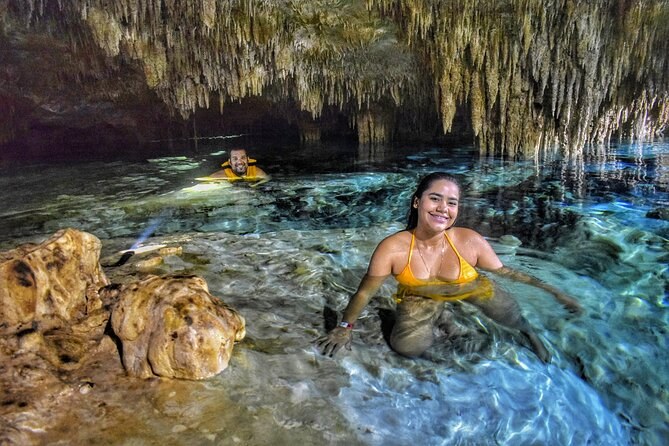
Is there a roof? An open cenote has sky above it, warms up, and is shallow at the edges. A cavern keeps its limestone roof, holds a steady temperature all year, and has stalactites coming down to meet the water. Those are two different days.
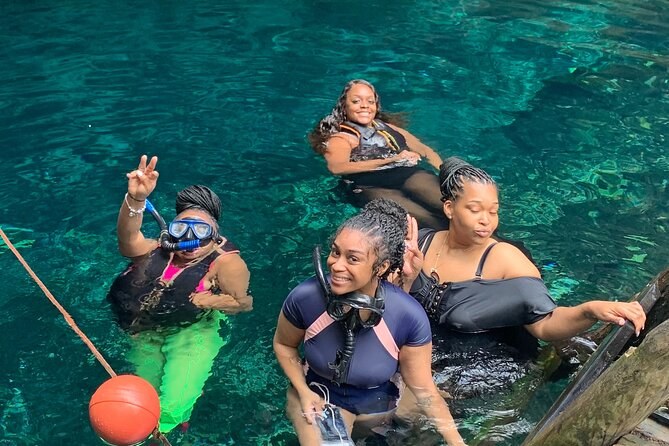
How deep is the middle? Three metres means a nervous swimmer can stand. Sixteen means there is nowhere to put your feet, which changes what you bring and who you bring it with.
Can you get there yourself? Four of these seven are on one flat road out of Tulum town. Two are up a limestone track off the highway. That is the difference between a bicycle and a booking.
The seven, ranked by what they ask of you
Easiest first. This is not a quality ranking — the hardest one on this list is arguably the best — it is a ranking of what you need to bring in order to enjoy it.
| Cenote | Type | Depth | What it asks of you | Best for |
|---|---|---|---|---|
| Cenote Zacil-Ha | Open, pool-shaped | 3 m throughout | Nothing | Small children, non-swimmers, a lazy afternoon |
| Gran Cenote | Half open, half cavern | Shallow at the edges | A mask, and an early start | A first cenote, and turtles |
| Casa Cenote | Brackish channel | Waist to chest | A mask, or a paddleboard | Wildlife, mangrove, a slow float |
| Cenote Car Wash | Open pond | 18 m | A mask, absolutely | Snorkellers who look down |
| Cenote Taak Bi Ha | Fully enclosed cavern | 8 m | Comfort in enclosed water | Photographs, and stalactites |
| Cenote Calavera | Roofed sinkhole | 16 m in the middle | A jump, or the ladder, and no shallow shelf | Confident swimmers |
| Cenote Dos Ojos | Cavern, two sinkholes | Deep, roofed span | A guide, and nerve | Cavern snorkelling and cavern diving |
Depths and types from published survey and guide sources; what each asks of you is a judgement drawn from those facts.
Which cenote should you swim first?
Gran Cenote, and the reasoning is not that it is the best. It is that it is two cenotes in one: an open pool on one side and a roofed cavern on the other, ten metres apart.
Swim both halves and you will know within twenty minutes whether you want sky or stalactites for the rest of your trip. Every other cenote here answers one of those questions and not the other, so starting anywhere else costs you a day finding out.
Gran Cenote — the one everybody starts with
Four to five kilometres out on the Cobá road, with freshwater turtles in the shallow half and bats under the roofed one. The water holds around 73–75 °F all year, which after an hour in the heat feels sharper than that.
It is also a main entrance to Sistema Sac Actun, the flooded cave system surveyed at 378.56 kilometres underwater. You will not see any of that from the swimming area, and knowing it is there changes the swim anyway.
The catch: it is the most visited cenote in the area and by eleven the shallow half is standing room. Nine o'clock is the whole trick, and it is the trick on this entire coast.
Cenote Taak Bi Ha — the one with no sky
Inside Parque Dos Ojos, opened to the public only in 2018, and run by a Maya cooperative that charges separately from the main park gate. Eight metres deep, held at 25–26 °C in every month of the year, and lit.
The lighting is the point. Everywhere else on this coast a photograph depends on the hour, because the picture is a shaft of daylight through a roof hole. Here the cooperative installed lamps, so the chamber looks the same at nine in the morning and three in the afternoon.
The catch: there is no opening to the sky at any point. If enclosed water bothers you at all, this is the wrong cenote and Cenote Zacil-Ha is the right one.
Casa Cenote — the one that runs to the sea
Not a sinkhole. A brackish channel roughly 230 metres long, winding through mangrove fifteen minutes north of town, where the groundwater under this whole coast finally reaches the Caribbean.
You float it rather than swim it, and the interesting layer is a metre down where fresh water sits on salt and the view goes briefly oily. The mangrove roots hold fish in numbers no inland cenote manages.
The catch: a resident Morelet's crocodile, and since May 2026 Tulum's authorities have restricted swimming and diving alongside the animals after a visitor was bitten. Watch from a board or the bank — the safety page has the detail.
Cenote Dos Ojos — the one under the whole system
Two sinkholes a short walk apart, joined underwater. Snorkellers stay in the lit span between them; certified cavern divers follow one of two named guidelines — the Barbie Line, about 415 metres through bright galleries, or the Bat Cave with its air dome.
The system was surveyed at 82 kilometres with 28 cenote entrances, and in January 2018 it was found to connect to Sac Actun and became part of it. Inside it is The Pit, 119.1 metres deep, the deepest known cave passage in Quintana Roo.
The catch: the gate is on the highway and the water is a rough track further in, so this is the one where a vehicle stops being optional.
Cenote Calavera — the one you jump into
Cenote Calavera has three holes in its roof that read as a skull from above, which gives it both its names. You drop through the largest of them, or take the ladder bolted beside it, into water that is three metres deep at the edges and fifteen or sixteen in the middle.
Divers pass three separate haloclines here, the first at about ten metres. From the surface what you see is the light from three openings converging in one body of water, which is why it photographs the way it does.
The catch: there is no shallow shelf to stand on and get your breath. Take the life jacket, and do not bring a small child.
Cenote Car Wash — the one that hides its best half
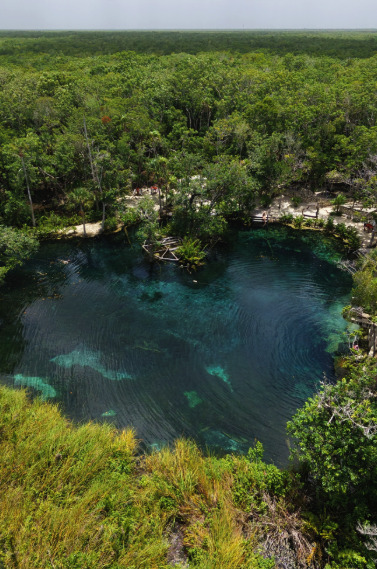
Eight kilometres out on the Cobá road, and from the bank it looks like the least impressive cenote on this list: a green pond with lilies on it. Then you put your face in.
Below the lily layer the water goes glass-clear over a drowned garden of branches, roots and fallen trunks, lit through the leaves from above. It reaches about eighteen metres and divers work here regularly.
The catch: without a mask you will see none of it, and small crocodiles are occasionally present in the vegetated margins. It is also called Aktun Ha, which is its real name.
Cenote Zacil-Ha — the one for children
Eight and a half kilometres out, immediately past Car Wash, and about three metres deep from edge to edge. There is a zipline over the water and two built swimming pools beside it.
Purists find the pools unserious. Anybody travelling with a four-year-old finds them the reason a family can stay three hours here, which no other cenote on this coast allows.
The catch: there is nothing dramatic about it. If you want stalactites or a jump, this is not the stop — and that is exactly why it works for everyone the others exclude.
Are they really all the same water?
Three of them literally are. Gran Cenote, Cenote Dos Ojos and Cenote Taak Bi Ha are separate entrances to Sistema Sac Actun, and swimming any of them is swimming a different room of one flooded cave.
That is not a curiosity. It means the question is never which cenote is best, because the water is identical. The question is which door you want: a shallow one with turtles, a pair of sinkholes with guidelines running out of them, or a sealed chamber lit by a cooperative.
Casa Cenote is the exception and the reason it is worth a separate morning. It is where all of that water finally reaches the Caribbean, which makes it brackish, layered and full of species none of the others hold. If you swim only two cenotes here, make one of them an inland cavern and one of them that channel.
The four mistakes people make choosing
Booking on a photograph. Every cenote photograph on this coast is clear water in pale limestone. The picture cannot tell you whether there is a roof, and the roof is the decision.
Assuming a park is a cenote. Parque Dos Ojos contains several, under different management, charged separately. Several departures enter the park and swim Taak Bi Ha rather than Cenote Dos Ojos, which is a different place entirely.
Choosing the famous one and arriving at eleven. Gran Cenote at half past eight and Gran Cenote at eleven are two different experiences at the same price. If you cannot make the morning, take an enclosed cenote instead, where the hour changes nothing.
Taking a small child to the wrong one. Calavera has no shallow shelf and Taak Bi Ha has no sky. Cenote Zacil-Ha is three metres deep throughout and has a zipline, which is a different kind of day and the right one.
Which are worth booking, and which are worth a bicycle?
Three of the seven — Calavera, Car Wash and Zacil-Ha — have no departure that enters them, and there is no reason they should. They are within nine kilometres of town on flat road, they take cash at the gate, and an operator has nothing to sell you that a colectivo does not.
What a booking genuinely buys is the other end of the list: the cavern cenotes off the highway, up a track, behind a second gate payment, with the gear and the fees handled. That is a real service and it is priced like one.
Gran Cenote sits between the two. You can bicycle to it, and two departures include its admission in the fare and pair it with cenotes you could not reach alone. The channel guide costs both versions out properly.
Frequently asked questions
What is the best cenote in Tulum?
It depends on one question: do you want sky above you or a roof? For sky, Gran Cenote or Zacil-Ha. For a roof, Taak Bi Ha. Gran Cenote is the honest first answer because it is both, ten metres apart, so you find out which you prefer.
Which cenote is least crowded?
Cenote Zacil-Ha and Cenote Car Wash, because the coaches are not interested in them. Everywhere else, the answer is not which cenote but which hour: before nine any of them is quiet, and by eleven the famous ones are not.
Can you swim in all seven?
Yes. None of them requires a certification to swim, and life jackets are provided or hired at every one. Cavern diving at Dos Ojos and Car Wash is a separate product with its own qualification.
Which cenote has the clearest water?
The enclosed ones, and for a structural reason: nothing washes into a sealed chamber, so heavy rain inland does not touch them. Taak Bi Ha holds its visibility in a month when the open cenotes lose theirs for a day or two.
Tulum Cenote Tours sets every departure against the others on length, group cap and what the fare covers. Tulum Cenote tours and tickets sorts the same list by price.
Departures that fit this guide
Chosen for what this guide argues, not for what sells.