Why there is no single price for a cenote
Every cenote near Tulum sits on private land. An ejido, a Maya cooperative or a family owns the hole in the ground, cuts the steps, runs the showers and sets the entry price. There is no ministry setting a tariff and no authority publishing one.
The consequence is that a handful of guides will give you a handful of different figures for the same cenote, all written in good faith and none of them current. That is why this site prints none, and why the visiting page puts the sourced numbers — what the operators charge — in their place.
What each operator actually collects
Twelve of the twenty-one departures bundle every fee into the fare. Nine collect something on the morning, and the amounts are not close to each other.
| Operator | Collected on the day | Covering | How |
|---|---|---|---|
| Cancun Travel Experience | MX$750 per person | MX$420 government tax, MX$100 Tulum fee, MX$230 natural reserve | Cash, on the day |
| Amigo Tours | US$44 per person | Archaeological site admission for Tulum and Cobá | Card only, on site |
| Ocean Tours Mexico | US$25 + US$35 per person | Government fees, plus a marine conservation bracelet | Cash, at pickup |
| Sat Mexico Tours | US$30 per person | US$25 cenote conservation and US$5 archaeological zone | On the day |
| Cancun Adventures | US$15 per person | Tulum archaeological site entrance only — cenote and lagoon are in the fare | On the day |
| NS Vacations Tours | US$25 per person | US$10 Tulum reserve tax and US$15 turtle protection programme | Cash, on the day |
| Mexico Highlights | US$15 per person | Natural reserve fee at the archaeological site | On the day |
Every charge here is one operator's own, stated on its own listing and captured 27 August 2026. No cenote gate figure appears, because no cenote publishes one.
Read that against the fares and the pattern is the opposite of what you would expect. The cheapest headline on this coast carries the largest surcharge on top of it, card only. Several of the dearest carry nothing at all.
Hours, and the hour that matters
Gates open at about eight and stop admitting swimmers in the mid-afternoon. Because each cenote is run by whoever owns it, those edges move without notice.
The hour that decides your visit is nine, when the first coaches reach the Cobá road, and eleven, by which time the popular cenotes are full. Every traveller who describes having a cenote to themselves arrived in the first hour of the day.
Getting there, four ways
- Bicycle. Flat road, and it reaches four of the seven cenotes with a page here — Calavera at a kilometre and a half, Gran Cenote at four to five, Car Wash at eight, Zacil-Ha at eight and a half.
- Colectivo. Shared vans run that road all morning for a few pesos and stop wherever you ask. Flag one back before the late afternoon.
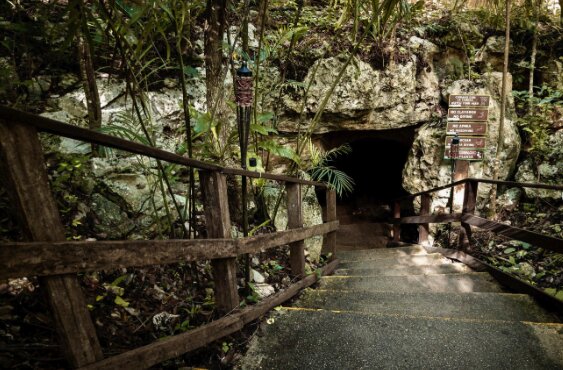
- Rental car. Opens the cavern cenotes off Highway 307, where the gate and the water are not the same place.
- A booked departure. Handles the track, the gates, the gear and the timing, which is what it is actually selling.
What you cannot take in
Sunscreen, at most of them, biodegradable included. A cenote is groundwater with no current to flush anything out, so what goes in stays. Apply at your hotel and cover up with a rash guard — the packing page is built backwards from this one rule.
Single-use plastic bottles are refused at the Tulum archaeological site. Devices are banned from the water at three of these cenotes, and at the archaeological site a GoPro, a tablet or a selfie stick attracts a fee at the booth. Drones are prohibited there outright.
How much time to allow
Forty minutes swims a cenote. Ninety is a comfortable visit with time on the deck. Three cenotes is the comfortable maximum in a day and two is the honest sweet spot, which is exactly the format the half-day departures use.
If what you want is a morning in one place, no tour sells that and no tour needs to. That is a gate fee, a colectivo and a whole day of your own. The planning page costs both versions out.
Swimming, safety and who it suits
You do not need to swim well for an open cenote — the edges are shallow and a life jacket does the rest. A cavern is different, because there are stretches with nowhere to stand.
Minimum ages on the bookable departures are real: three set a floor of six with a 1.20 m height minimum, one sets five, four take infants only on a lap. At a gate you walk up to there is no limit. The safety page covers the water, the wildlife and the rule that changed in May 2026.
What to bring, in one line
Swimwear under your clothes, a towel, water shoes with a grip, a second set of everything and a bag for the wet set, a mask if you own one that seals, and pesos in small notes. Leave the sunscreen, the large notes and anything valuable at the hotel.
Questions this raises
Do I need to book a cenote tour in advance?
A few days ahead between December and April, a day or two the rest of the year. The constraint is the small departures rather than availability in general: two of them cap at five and ten travellers. Everything refunds in full at 24 hours, so booking early costs you nothing.
Can I pay by card at a cenote?
Assume not. Machines exist at one or two of the larger sites and fail often enough that nobody local depends on them. The exception runs the other way: the Coba combination day takes its archaeological admission by card only.
How early is early enough?
Before nine. The first coaches reach the Coba road at about nine and the popular cenotes are full by eleven. That ninety-minute window is the difference between an empty limestone amphitheatre and a queue for the stairs.
What if it rains on the day I have booked?
You go anyway. The water is groundwater and does not care what the sky is doing, and a warm downpour over a roofed cenote is one of the better experiences here. Heavy rain inland does cut visibility in the open cenotes for a day or two.
Book the version whose fare covers the gate and the only number you will not know in advance is the tip. Tulum Cenote Tours sets every departure against the others, and every Tulum Cenote tour compared sorts them by what the fare covers. Tulum Cenote tours and tickets sorts the same list by what you actually pay.
Departures that fit this question
Chosen for what this post covers rather than for what sells.