Why the names matter more here than anywhere else
A listing that says "swim in a cenote" is selling you a category, not a place. An enclosed cavern at 25 °C and an open pool three metres deep are two days you would plan differently. Both get sold to you with the same sentence.
Read the itinerary, not the title. It is the one habit worth taking into a booking page. The comparison page does that job for you on the seven that carry enough verifiable fact to fill a page of their own.
All seventeen, in one table
| Cenote | Where | What it is | Departures | Detail |
|---|---|---|---|---|
| Gran Cenote | Cobá road, 4–5 km | Half open, half cavern | Two departures | Own page |
| Casa Cenote | Coast road, 15 min north | Brackish mangrove channel | Three departures | Own page |
| Cenote Dos Ojos | Parque Dos Ojos, Hwy 307 | Cavern, two sinkholes | One departure | Own page |
| Cenote Taak Bi Ha | Inside Parque Dos Ojos | Fully enclosed cavern | Three departures | Own page |
| Cenote Calavera | Cobá road, 1.5 km | Roofed sinkhole, jump entry | None | Own page |
| Cenote Car Wash | Cobá road, 8 km | Open pond with lilies | None | Own page |
| Cenote Zacil-Ha | Cobá road, 8.5 km | Open, pool-shaped, 3 m | None | Own page |
| Cenote Nohoch Nah Chich | Inland, off the Cobá road | Cave system, swum with a guide | Three departures | Below |
| Cenotes Sac Actun | Near Chemuyil | Underground river | Two departures | Below |
| Cenote el Sueño | Riviera Maya | Guided cavern eco-swim | Two departures | Below |
| Parque de Cenotes Yax-Muul | Riviera Maya | Cavern with stalagmites | Two departures | Below |
| Cenotes Casa Tortuga | Tulum, off Highway 307 | Four cenotes on one site | One departure | Below |
| Cenote Zemway | Tulum area | Jump platforms, 15 and 18 ft | One departure | Below |
| Cenote Mariposa | Tulum area | Open, with lockers on site | One departure | Below |
Every cenote named in the itinerary of a departure listed here, captured 27 August 2026. The last column says whether it has a page of its own.
The seven with their own page
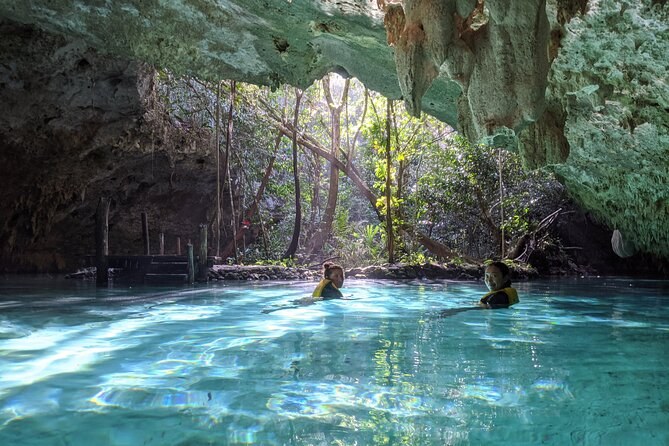
Gran Cenote is the one you will swim first. Half open water with freshwater turtles under you, half stalactite cavern. It is also a main entrance to Sistema Sac Actun. Casa Cenote is your outlier — a brackish channel through mangrove where the groundwater meets the sea, and you float it rather than swim it.
At Cenote Dos Ojos you snorkel the lit span between two sinkholes. At Cenote Taak Bi Ha you drop into a sealed, lit chamber inside the same park. You jump into Cenote Calavera. You put your face in at Cenote Car Wash to find the forest under the lilies. And you take your children to Cenote Zacil-Ha.
The other ten, and which trip reaches them
Cenote Nohoch Nah Chich
Three departures name it, which makes it the one you are most likely to swim without ever learning what it is called. You go in with a guide. Book one of the two long combination days and you get two to three hours there, which is the longest single water stop on this coast.
Cenotes Sac Actun
Two private departures take you in at the Sac Actun entrance near Chemuyil for an underground river swim, and one of them gives you three hours. You are in the same system Gran Cenote opens into, entered somewhere much quieter than you would expect.
Cenote el Sueño
Your cavern on either of the two four-in-one days, and you swim it with a guide in the water beside you rather than being dropped at a gate. Allow an hour to ninety minutes.
Parque de Cenotes Yax-Muul
A cavern full of stalagmites in the forest, and you reach it on either of two Ocean Tours departures with ninety minutes to two hours to use. Your entry is inside both fares, so you pay nothing at the gate.
Cenotes Casa Tortuga
Four cenotes on one site, and if you take the all-inclusive small-group day you get two hours and ten minutes there. This is what people mean when they tell you they did several cenotes in one stop.
Cenote Zemway, Cenote Mariposa and the rest
Zemway opens your three-cenote half day with jump platforms at fifteen and eighteen feet, and the ladder is there if you would rather. Mariposa is a straightforward open swim with lockers, on the long Cancun day. Two operators will not name their cenote at all. You get "our own cenote" or a jungle cenote, which is worth knowing before you book on the strength of a photograph.
How to pick one from a listing
- Read the itinerary, not the title. Several trips sell "Dos Ojos" and enter the park to swim Taak Bi Ha instead — a different cenote entirely.
- Check whether admission is included per stop. The listings mark it, and it is the difference between a fare you can budget and one you cannot.
- Count the minutes, not the stops. Forty minutes at three cenotes is a survey; two hours at one is a swim.
- Ask what "our cenote" means. If nobody will name it, you are booking a photograph rather than a place.
Tulum Cenote tour lists every departure with the cenotes its own itinerary names, and the planning page turns that into a day.
Questions this raises
How many cenotes are there near Tulum?
More than anybody has counted, because a cenote is any collapse into the flooded cave system and the system runs for hundreds of kilometres. Seventeen are named across the departures listed here. Seven of those carry enough verifiable fact for a page of their own.
Which cenote do most tours actually visit?
Cenote Nohoch Nah Chich, named by three departures, which makes it the one you are most likely to swim without learning its name. Gran Cenote, Taak Bi Ha and Casa Cenote follow with two or three each.
What does it mean when a listing says 'our cenote'?
It means the operator has an arrangement with a landowner and would rather you booked on the photograph than on the name. Two of these listings do it. Ask which cenote before you book, and treat a refusal as an answer.
Is Cenote Dos Ojos the same as Parque Dos Ojos?
No, and this is the most common confusion on this coast. The park is land containing several cenotes under different management; Cenote Dos Ojos is one of them. Several trips enter the park and swim Taak Bi Ha instead.
Pick the cenote first and the departure second — that order is the whole point of knowing seventeen names. Tulum Cenote Tours sets every departure against the others, and all Tulum Cenote tours and tickets sorts them by what the fare covers.
Departures that fit this question
Chosen for what this post covers rather than for what sells.