What Cenote Zemway is for
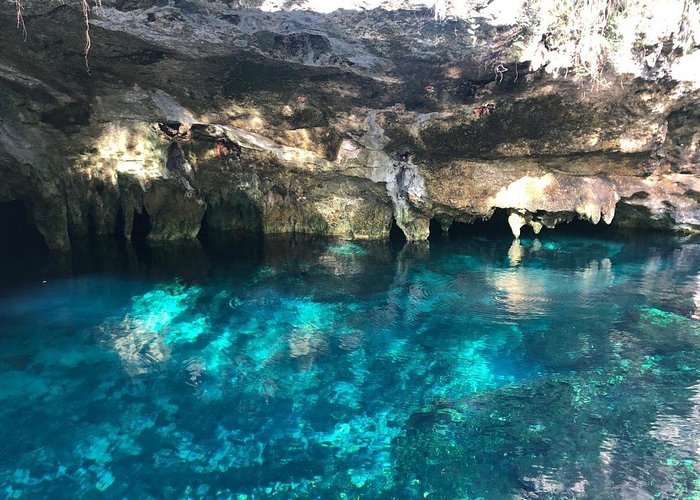
Not every cenote needs to be a cathedral. Zemway is an open cenote with platforms and rope swings over the water, and its appeal is straightforwardly physical: you jump in, you climb out, you do it again. It is the loudest and least formal stop on the tour that reaches it, and for confident swimmers and teenagers it is frequently the one they talk about afterwards.
That matters more than it sounds when you are choosing a cenote day. The famous cenotes on this coast are appreciated rather than played in — boardwalks, guides, quiet cavern swims. A jumping cenote is a different mood, and a group that includes teenagers usually needs one on the itinerary.
Admission is free here, which is unusual
On the tour that confirms Zemway in its itinerary, admission at this stop is recorded as free rather than included — a distinction worth noticing on a coast where nearly every cenote charges at the gate and several charge more than the tour fare.
That is the operator's own statement about its own itinerary, and it is one of the reasons that tour ends up costing what it advertises. It is one of only a handful on this site that collect nothing at all on the day. See costs, fees and timing for how rare that is.
What is not published
Zemway does not publish opening hours or a gate price that any independent source states, and it does not appear in the standard published guides to Tulum's cenotes. Like a great many cenotes on this coast it sits on private or communal land and reaches visitors through an arrangement with an operator rather than through a ticket window.
There is no way to invent a location, an opening time or a price for it. What is stated here is what the itinerary confirms: the stop, the duration, and that admission is free.
Why an open cenote belongs on a cave-heavy coast
The cenotes that get written about around Tulum are overwhelmingly the roofed ones, because they photograph dramatically and because a cavern swim is the novel experience. But a day made entirely of cave cenotes is colder, darker and more passive than most groups want, and there is nowhere in one to simply sit in the sun.
An open jumping cenote balances that. It is warmer, brighter, noisier and physical, and it is where a group tends to relax after an hour of following a guide through a dark passage single file.
Jumping safely
The general rules for jumping cenotes apply and are worth stating, because this is where injuries on this coast actually happen.
- Enter feet first, always. Depth varies across a cenote and rock ledges are not always visible from above.
- Watch someone else go first and note where they land.
- Never jump onto anyone. Wait for the water to clear.
- Wet rock is slippery. Most incidents happen on the climb out, not the jump.
- Follow the guide. They know which platforms are in use and which are not.
More general guidance is on safety and access.
The tour that reaches it
One tour on this site confirms Zemway in its itinerary, and it is a well-designed morning: three cenotes at forty minutes each, from a fixed meeting point in Tulum Centro rather than a hotel collection loop, back before lunch. The three are deliberately unalike — Gran Cenote is a semi-open swim with a cavern passage, Casa Cenote is a mangrove channel where fresh water meets salt, and Zemway is the jumping one.
Seeing three genuinely different kinds of cenote in one morning teaches you more about what a cenote is than a single stop at the most famous one. That, plus no fee at any gate and a four-hour day rather than twelve, is why it is one of the featured tours on this site. Compare it against the other half-day cenote tours.